NVIDIA ICMS: Storage at the Bus Edge
At CES/GTC 2026, NVIDIA announced ICMS (Inference Context Memory Storage, aka CMX) — a pod-level, flash-backed KV Cache tier for the Vera Rubin platform [8][9]. BlueField-4 DPUs in dedicated flash enclosures, Spectrum-X Ethernet for RDMA transport, delivering 5× token throughput over traditional secondary storage [8]. The bet: push storage toward the GPU — solve the memory wall at the bus edge.
ICMS is essentially a G3.5 tier: faster than network storage (G4), slower than HBM (G3), managed by DOCA/Dynamo/NIXL for KV block pre-staging.
How Google Thinks About Long-Context KV Cache Systems
Our previous analysis found that 99.1% of tokens in a long-context Agent session are "remembered," not "computed" [1]. The storage:compute ratio reaches 42.7:1. As Google's own blog puts it: "The KV Cache's immense GPU memory footprint, amplified by system prompt size, is the primary bottleneck in LLM serving, directly constraining context length, concurrency, and overall system throughput." [2]
This is Google's concern: at 42.7:1 storage:compute ratio [1], KV Cache is the workload. Compute is almost an afterthought.
How does Google design the storage system around it? The answer is not one solution — it's two complementary approaches, each optimized for different workload characteristics.
Approach 1: Node-Local Tiered Storage (HBM + CPU RAM + Local SSD)
Google's collaboration with LMCache [11] demonstrates a tiered storage approach on GKE. The core idea: extend KV Cache from GPU HBM to larger, cost-effective node-local tiers, keeping all data on the accelerator node.
Experiment setup: A3 mega node, 8× H100 Mega 80GB GPUs, Llama-3.3-70B-Instruct, LMCache v0.3.3, vLLM serving.
| Tier | Capacity | Role |
|---|---|---|
| HBM (Tier 1) | 640 GiB | Fastest, smallest — fits ~1.1M–1.3M tokens |
| CPU RAM (Tier 2) | 1 TiB | Mid-speed extension — total ~4M–4.3M tokens |
| Local SSD (Tier 3) | 5 TiB | Largest, slowest node-local — total ~12M–13M tokens |
Benchmark command:
python3 sglang/bench_serving.py --host=${IP} --port=${PORT} --dataset-name='generated-shared-prefix' --model=$MODEL --tokenizer=$MODEL --backend=vllm --gsp-num-groups=80 --gsp-prompts-per-group=20 --gsp-system-prompt-len=1000 --gsp-question-len=256 --gsp-output-len=512 --request-rate=800 --max-concurrency=200
Test 1: Cache fits in HBM (1.1M–1.3M tokens). Adding slower storage tiers offered no advantage. HBM-only is optimal.
Test 2: Cache exceeds HBM (4.0M–4.3M tokens).
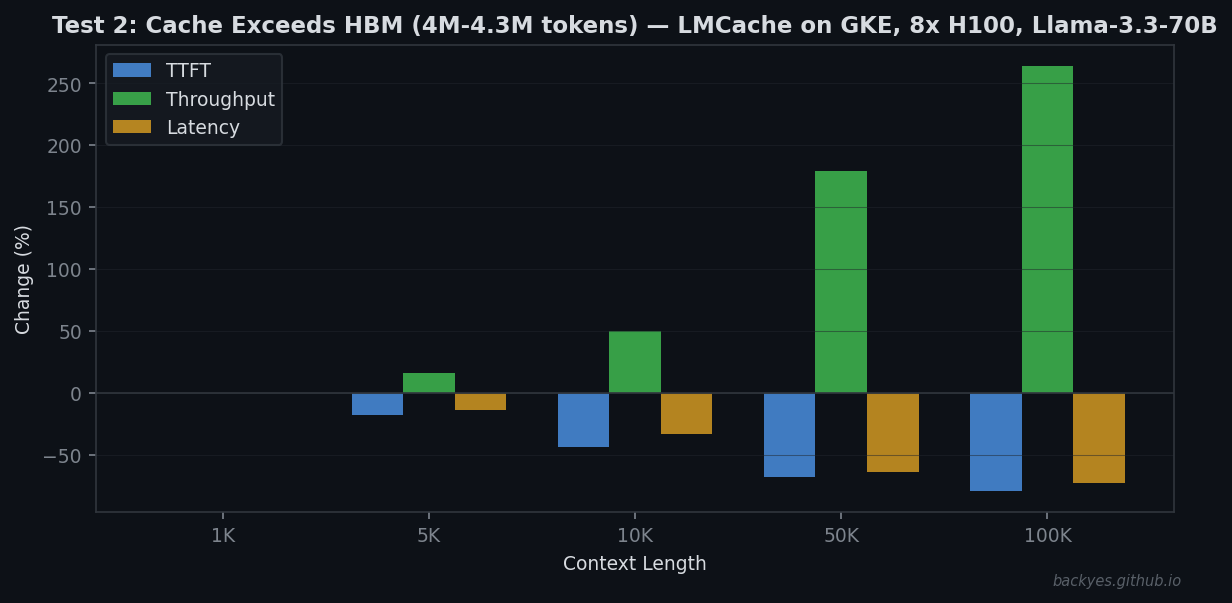
Test 2: A3 mega, 8× H100, Llama-3.3-70B. Cache exceeds HBM (640 GiB) but fits within HBM + CPU RAM (1.7 TiB total). TTFT blue, Throughput green, Latency amber.
| Context | Best Setup | TTFT | Throughput | Latency |
|---|---|---|---|---|
| 1K | HBM only | Baseline | Baseline | Baseline |
| 5K | HBM + CPU RAM | −18% | +16% | −14% |
| 10K | HBM + CPU RAM | −44% | +50% | −33% |
| 50K | HBM + CPU RAM + SSD | −68% | +179% | −64% |
| 100K | HBM + CPU RAM + SSD | −79% | +264% | −73% |
At 100K context, node-local tiered storage delivers 2.6× throughput (+264%) and 73% latency reduction vs HBM-only. The cache stays on the node — no network round-trips.
Test 3: Cache saturates HBM + CPU RAM (12.6M–13.7M tokens), spills to Local SSD.
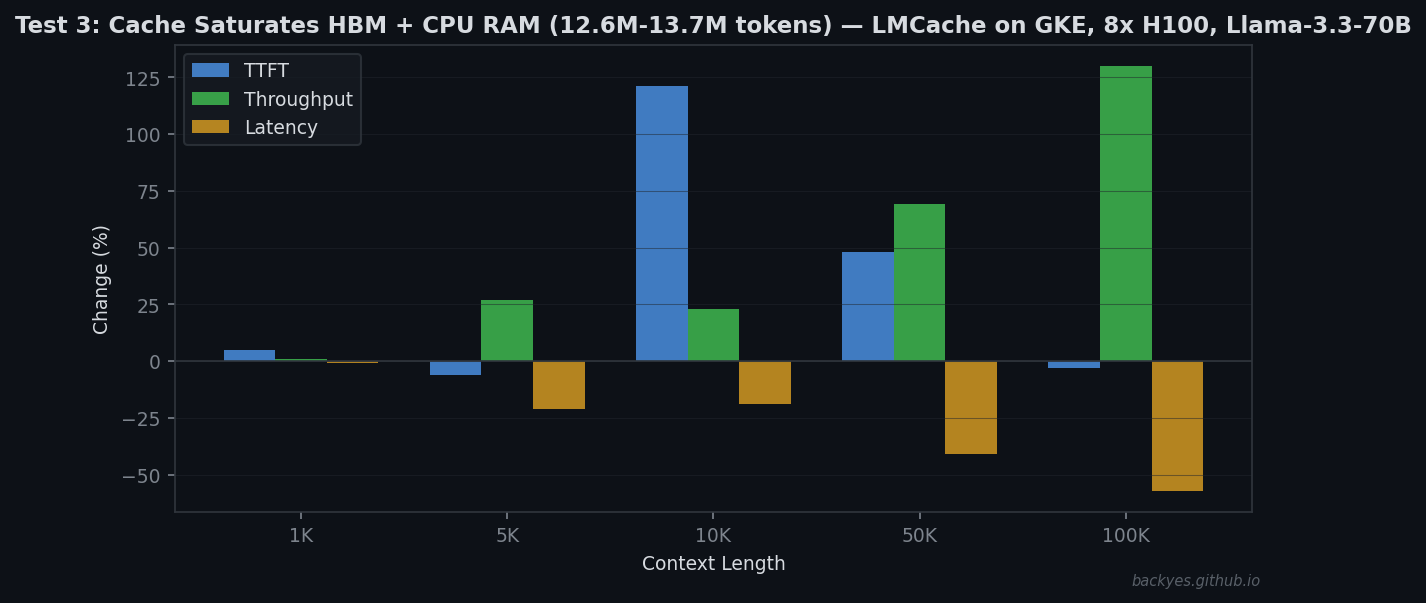
Test 3: Same setup. Cache saturates HBM + CPU RAM, spills to Local SSD (5 TiB). Throughput still gains, but TTFT degrades at 10K–50K — the cost of SSD spillover.
| Context | Best Setup | TTFT | Throughput | Latency |
|---|---|---|---|---|
| 1K | HBM + CPU RAM | +5% | +1% | −1% |
| 5K | HBM + CPU RAM | −6% | +27% | −21% |
| 10K | HBM + CPU RAM + SSD | +121% | +23% | −19% |
| 50K | HBM + CPU RAM + SSD | +48% | +69% | −41% |
| 100K | HBM + CPU RAM + SSD | −3% | +130% | −57% |
Even with SSD spillover, 100K context still delivers +130% throughput. But TTFT degrades when cache exceeds comfortable capacity — signaling the practical limit of node-local approaches.
🔍 Open question: Why does TTTT degrade at 10K–50K but recover at 100K, while throughput keeps improving?
One hypothesis (worth discussing): At 10K–50K, the cache is in a "worst of both worlds" regime — too large for fast memory, too small to amortize SSD I/O costs. By 100K, the workload may reach a new steady state where massive cache hit rates and batch efficiency outweigh the SSD latency penalty. But this is speculation — the actual cause could be vLLM scheduling behavior, SSD read-ahead effects, or KV Cache eviction dynamics. The data raises the question; it doesn't answer it.
Key insight: Tiered node-local storage works best when the cache fits within HBM + CPU RAM. SSD spillover still helps throughput but adds latency. The ceiling is node capacity.
Limitation: Node-local storage is fixed in size and cannot be shared across nodes. For multi-tenant or larger-than-node workloads, a different approach is needed.
Approach 2: Centralized Shared Storage (Managed Lustre)
For workloads that exceed node-local capacity or require multi-tenant sharing, Google recommends Managed Lustre [2]:
"We believe that Google Cloud Managed Lustre should be your primary storage solution for external KV Cache."
Why not just local SSD?
Google's blog [2] makes the case:
"On GPUs, Lustre is assisted by locally attached SSDs. And on TPUs, where local SSDs are not available, Lustre's role is even more central."
"While Local SSDs and CPU RAM are effective node-local tiers, they are fixed in size and cannot be shared. Managed Lustre provides a parallel file system to act as the massive, high-throughput external storage, making it a great solution for large-scale, multi-node, and multi-tenant AI inference workloads where the cache exceeds the capacity of the host machine."
The key insight: local SSDs can be shared in distributed setups, but their I/O bandwidth is limited by host NIC capacity. Lustre provides higher aggregate bandwidth and centralized sharing — critical for long-context workloads where KV Cache sizes reach terabytes.
Performance data [2]: DeepSeek-R1 on A3-Ultra (8× H200, 8× 141 GB HBM), 50K token context, ~75% cache hit rate, ~3.4 TiB total KV Cache.
| Metric | Result |
|---|---|
| Inference throughput | +75% vs host memory only |
| Mean time to first token (MTTF) | −40%+ vs host memory only |
| I/O parallelism | 32 worker threads for KV reads |
"In an experiment with a 50K token context and a high cache hit rate (about 75%), using Managed Lustre improved total inference throughput by 75% and reduced MTTF by more than 40% compared to using KV Cache in host memory alone." [2]
TCO analysis [2]: Workload processing 1 million TPS using A3-Ultra VMs + Managed Lustre.
| Metric | Result |
|---|---|
| TCO reduction | 35% vs no external storage |
| Accelerator savings | ~40% fewer GPUs needed |
| Key insight | "Storage replaces compute" — offloading KV to I/O frees accelerators |
"TCO analysis yielded a 35% savings from using an external attention/KV Cache for a workload processing 1 million Tokens per Second (TPS)... when compared to a workload leveraging no external storage." [2]
"You can handle a specific number of queries per second with ~40% fewer accelerators, resulting in direct cost savings." [2]
Configuration details [2]:
| Parameter | Value |
|---|---|
| Lustre bandwidth | 1000 MB/s per TiB (Performance Tier) |
| Capacity per machine | 18 TiB Lustre per A3-Ultra VM |
| Cluster size | 73 A3-Ultra machines for 1M TPS target |
| GPU | 8× H200 per VM, 8× 141 GB HBM |
| Software tuning | o_direct flag (bypass FS cache), 32 I/O worker threads |
"Our experiment demonstrated that with configuration tuning and an improvement in KV Cache software to adopt more I/O parallelism, Managed Lustre can substantially improve inference performance." [2]
"You can handle a specific number of queries per second with ~40% fewer accelerators, resulting in direct cost savings." [2]
The core argument: I/O bandwidth is the bottleneck. At 1000 MB/s per TiB, Lustre delivers 18 GB/s aggregate bandwidth per VM (==18 TiB × 1000 MB/s = 18,000 MB/s = 18 GB/s) — far exceeding what host NIC-attached local SSDs can provide. The storage cost is offset by compute savings: 40%== fewer accelerators for the same workload.
Rapid Storage: What It Actually Does
Rapid Storage (Rapid Bucket + Rapid Cache) is Google's high-performance object storage layer — built on Colossus, the distributed system that powers Gemini and YouTube [3].
| Product | Bandwidth | Latency | Primary Use |
|---|---|---|---|
| Rapid Bucket | 15 TB/s | Sub-ms (open file) | Training data, checkpoint write/restore |
| Rapid Cache | 2.5 TB/s | Sub-ms | Inference model weight loading (cold start) |
Rapid Storage is not designed for KV Cache externalization. Its strengths are:
- Accelerating training data loading (50% GPU blocked time reduction)
- Checkpoint write/restore (3.2× write, 5× restore speedup)
- Eliminating inference cold start (model weight pre-warming)
For KV Cache, Google's official recommendation remains Managed Lustre or node-local tiered storage [1][2][11].
Comparing the Three Approaches
| Node-Local Tiered (LMCache) | Centralized Lustre | Rapid Storage | |
|---|---|---|---|
| Architecture | HBM → CPU RAM → Local SSD | Parallel file system (RDMA) | Object storage (Colossus) |
| Proximity | Node-local | Cluster-level (network) | Regional |
| Sharing | Node-scoped | Multi-tenant | Zonal |
| KV Cache role | Primary (single-node) | Primary (multi-node) | Not for KV |
| Throughput gain | +264% (100K context) | +75% (50K context) | N/A |
| Context ceiling | ~100K (node capacity) | Unlimited (shared pool) | N/A |
| Best for | Single-node, latency-sensitive | Multi-tenant, capacity-bound | Training data, model weights |
What Comes Next?
Both KV Cache approaches prove the same point: at 42.7:1 storage:compute ratio, the storage layer determines inference cost and performance.
But Agentic AI is heading toward million-token contexts with 90–99% cache hit rates. Every percentage point of hit rate improvement means more data to move relative to compute.
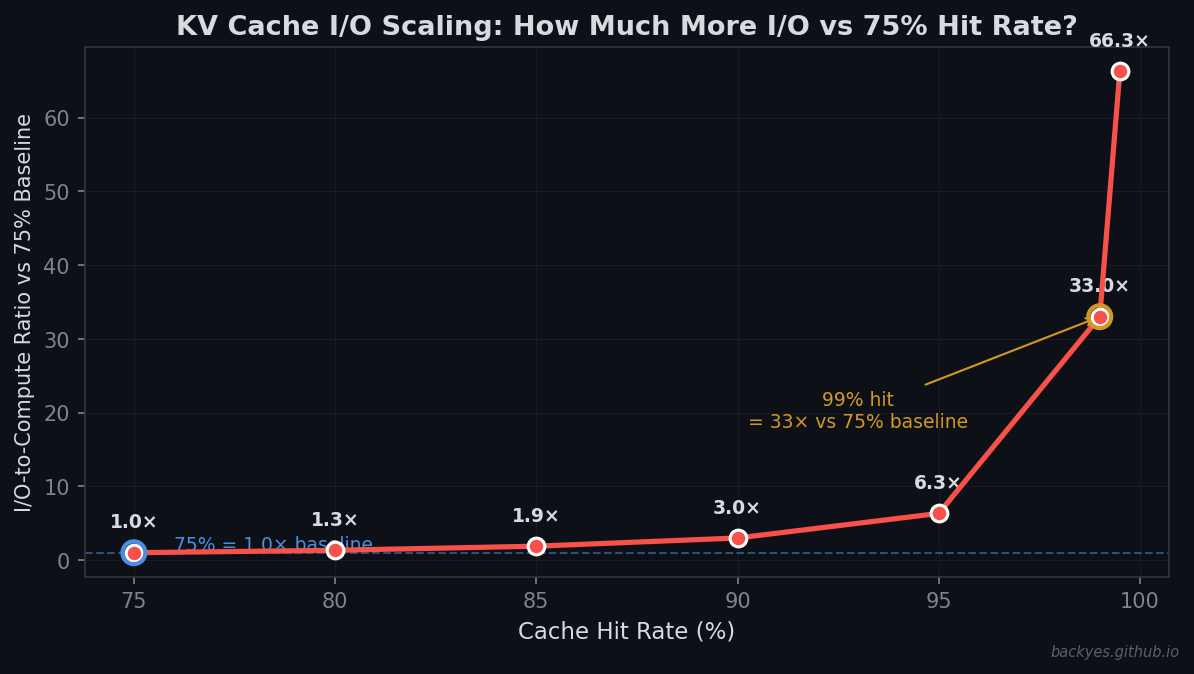
I/O-to-Compute ratio normalized to 75% baseline (for every 100 tokens):
- 75%: I/O:Compute = 75:25 = 3.0× → 1.0× (baseline)
- 80%: I/O:Compute = 80:20 = 4.0× → 1.3× vs baseline
- 85%: I/O:Compute = 85:15 = 5.7× → 1.9× vs baseline
- 90%: I/O:Compute = 90:10 = 9.0× → 3.0× vs baseline
- 95%: I/O:Compute = 95:5 = 19.0× → 6.3× vs baseline
- 99%: I/O:Compute = 99:1 = 99.0× → ==33× vs baseline==
- 99.5%: I/O:Compute = 99.5:0.5 = 199.0× → ==66× vs baseline==
The relationship is non-linear. Moving from 75% to 99% hit rate increases the I/O-to-compute burden by 33×. At 99.5%, it's 66× the baseline. This is the fundamental scaling challenge: as hit rates approach 100%, I/O demand explodes while compute shrinks to near-zero.
The open question: when KV Cache scales to millions of tokens, can Lustre keep up?
Google's Lustre solution delivers 75% throughput improvement today at 50K context. But it runs on a shared RDMA fabric with per-VM bandwidth derived from capacity: 18 TB Lustre capacity per VM × 1000 MB/s per TB (Performance Tier) = ==18,000 MB/s = 18 GB/s — shared across all tenants. At million-token scales with thousands of concurrent agents, the fabric becomes the contention point. Node-local tiered storage, meanwhile, hits a hard ceiling at node capacity (18 TiB== local SSD + 1 TiB CPU RAM + 640 GiB HBM).
Will Google also move toward on-node FLASH/NAND, following the TPU super-node path? As KV Cache grows to millions of tokens, even Lustre's shared RDMA fabric may not suffice. NVIDIA's ICMS already puts flash at the bus edge. Google's TPU strategy relies on massive on-package HBM — but as Agentic AI pushes context lengths further, will Google also adopt on-node FLASH/NAND tiers to complement Lustre? The answer may define the next era of AI storage architecture.
References
[1] backyes — The Million-Token Bill — 42.7:1 storage:compute ratio, 77× cache hit cost difference
[2] Google Cloud Blog — Choosing Managed Lustre for External KV Cache — 75% throughput improvement, 35% TCO savings, 40% fewer GPUs
[3] Google Cloud Blog — Next '26 Storage Announcements — Rapid Storage official positioning and performance specs
[4] Google Cloud Documentation — Storage services for AI and ML workloads — Official storage tier recommendations
[5] Google Cloud Blog — AI infrastructure at Next '26 — "Dedicated KV Cache scalable storage subsystem" announcement
[6] Google Cloud Blog — TPU 8t/8i technical deep dive — TPU 8i 384 MB SRAM designed for KV Cache
[7] Blocks & Files — Google's cloud storage gets faster and smarter for AI — Managed Lustre as shared KV Cache
[11] LMCache Blog — LMCache on GKE: Boosting LLM Inference with KV Cache on Tiered Storage — 264% throughput at 100K context, full benchmark data
© 2026 backyes · Created by backyes